When we talk about the history of agriculture, the Fertile Crescent often dominates the conversation. It was there, in 9000 BCE, that humans first began to cultivate the land. China and New Guinea followed around 7000 BCE. But for thousands of years, much of Africa—except for Egypt, which closely interacted with Southwest Asia—remained home to hunter-gatherers. The question that intrigued me as I researched this topic was: why did agriculture arrive in sub-Saharan Africa later, and what makes its story so unique?
Scientists generally agree that Africans turned to farming later precisely because Africa was the cradle of human evolution. This gave African animals a significant head start in adapting their instincts to avoid human hunters, making it much harder to domesticate the kinds of animals necessary for early farming. This helps explain why Africa still boasts so much of its megafauna—lions, elephants, giraffes—while other continents, like Australia and the Americas, saw much of theirs wiped out after humans arrived. Domesticating animals, a key step in the development of agriculture, proved a greater challenge on the African continent.
Interestingly, early farming wasn’t necessarily a step up in the quality of life. Foraging brought more varied diets and less work, while farming required intensive labor, increased vulnerability to diseases, and worse nutrition. It also brought risks—crops could be devastated by poor weather or natural disasters, leaving early farmers far more vulnerable than their hunter-gatherer predecessors.
There’s another fascinating theory behind the delay in agriculture: the absence of what archaeologists call “Gardens of Eden.” These were lush areas so rich in fruits, vegetables, and plant life that foragers could settle for a generation without needing to farm. However, over time, they would deplete these natural resources and be forced to either move on or farm to survive—a phenomenon known as the “Trap of Sedentism.” Africa, with its many challenging environments, didn’t offer as many of these ‘traps,’ allowing hunter-gatherers to continue their way of life for longer.
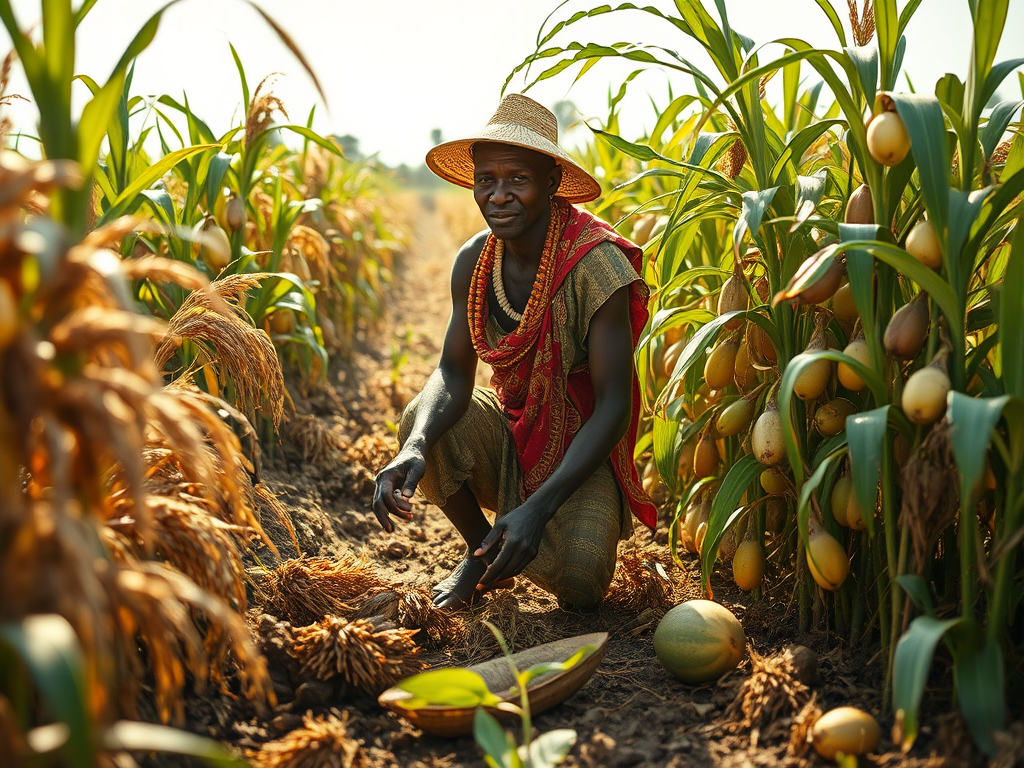
It wasn’t until between 3000 BCE and 1000 BCE that farming began to spread across West Africa. Farmers in this region grew millet, sorghum, rice varieties, tubers, yams, fruits, and melons, all suited to the local environment. Remarkably, West African farming developed independently—it didn’t derive from Egypt or the Fertile Crescent, making it one of the few regions in the world where agriculture arose on its own. It’s also worth noting that West Africa began farming around the same time as agriculture was taking root in the Americas.
This independence is one of the reasons I find the history of African agriculture so fascinating. Unlike many other places where farming practices were passed down or imported from neighboring regions, West Africans forged their own path. This innovation, in the face of challenging environmental conditions, is a testament to the adaptability and resourcefulness of early African communities.
This is just one of the many captivating stories from Africa’s past, and it’s a reminder that history is often more complex and nuanced than the broad strokes we’re sometimes taught. Stay tuned as I continue to explore the continent’s rich history and uncover more stories like this!


 Africa Defined
Leave a comment